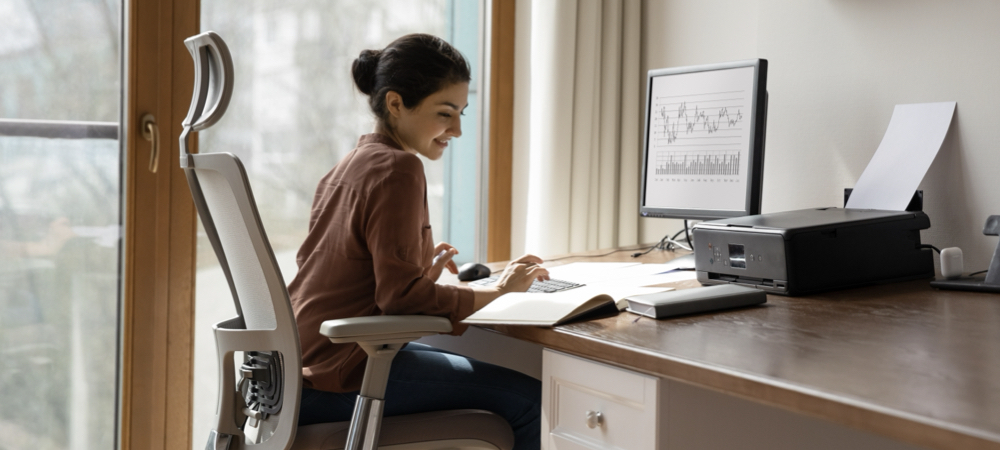
Imagine an ordinary morning: you wake up, make yourself coffee, open your laptop on the kitchen table and start working.

No commuting, no crowded open spaces. Everything looks easy. But at 10 a.m. you’re still wearing your pajamas, you’ve replied to thirty messages, you haven’t had breakfast yet and your back is already sore.

Without the right habits and boundaries, remote work can become the opposite of agile work: more stress, fewer boundaries and productivity that comes and goes.

So, what does working remotely really mean? And what practices can help make it effective and sustainable?

Apply now WORKING AT DE NORA

Want to join De Nora? Apply now!

1. What remote work means: more than just “from home”

Every country has different specific regulations for remote work, but the core idea is the same: a way of organizing work that goes beyond traditional time and spatial boundaries. It's more than working from home: it's an agreement between an organization and its people, built on autonomy and a focus on results, which aims at improving organizational wellbeing.

To explore this topic further, read the article "The role remote work plays in organizational wellbeing".

The distinction matters, because confusing remote work with simply 'working from home' leads to underestimating both the opportunities and benefits and the actual risks this way of working carries.

This is why there are also rules and good practices to follow in order to work at your best.

https://145358546.fs1.hubspotusercontent-eu1.net/hubfs/145358546/work%20remotely.001.jpeg

2. How to work remotely: rules that make a difference 

2.1 Working by objectives doesn’t mean working more 

One of the most common mistakes people make when they start working remotely is making up for the absence from the office with a constant digital presence: being always online, replying to messages immediately, monitoring chats and emails more than needed. As if office presenteeism had simply shifted to the computer screen.

Remote work actually came about with the opposite goal.

It was meant to give people flexibility and autonomy in managing their activities, spaces and schedules, increasing accountability. The keyword is results, not hours.

This shift in perspective involves both people and management. For people, it means planning the day according to priorities and the concrete goals to achieve.

For those coordinating a team, it means measuring the quality and impact of contributions rather than the number of hours spent online.

https://145358546.fs1.hubspotusercontent-eu1.net/hubfs/145358546/work%20remotely.002.jpeg

2.2 Working smarter around notifications and meetings

According to Microsoft Work Trend Index 2025 data, people who work with digital tools experience an interruption roughly every two minutes by a meeting, an email or a notification.

Around 275 interruptions a day. 57% of these meetings are arranged last minute, without a shared agenda, often during the hours of highest focus

The result is what researchers call 'digital debt': the feeling of working nonstop without being able to carry out activities that truly create value.

Working remotely amplifies this problem.
If the office environment can help alternate moments of conversation and moments of focus, when working remotely the line between attention and distraction becomes more blurred.

To work from home effectively you’ll need to learn how to manage communication with more awareness. Here are some useful questions to start with:

  • When do I read my emails? Don't do it continuously: set specific times dedicated to managing them.
  • Is this meeting really necessary? Information and updates can be shared via email, allowing people to read them when it best fits their schedule, thus reducing the number of interruptions;
  • Do I have to reply immediately to this request? Most of the time the answer is no. Setting clear expectations with the team about response times helps reduce availability anxiety.

It's not about being less collaborative, but about moving from a reactive logic, where you constantly respond to external stimuli, to an intentional logic, where you consciously decide how to manage your attention and energy. Techniques such as time blocking — dividing the day into thematic blocks — or the Eisenhower matrix to prioritize tasks are not abstract theories: they are practical tools that people working remotely should be familiar with.

2.3 Create rituals to begin and end the workday

As inconvenient as it may be, commuting serves an important purpose: it marks a boundary. The time spent commuting between home and the office is a natural transition that helps separate personal time from professional time: a way to enter work mode in the morning and exit it in the evening.

Working from home, this boundary disappears. And the brain, which relies on habits more than we think, struggles to distinguish between moments and tends to stay connected even after the workday ends. To prevent this from happening, you don't need strict rules, just mindful habits. Create micro-rituals to recreate those transition moments at the beginning and end of the day: a 10-minute walk before opening your laptop, physically closing your computer and tidying up your desk at the end of the day.

It might not seem like much, but these habits allow you to turn remote work into a tool for your wellbeing and productivity rather than a source of stress.

Successful remote work depends on much more than technology. It requires a results-oriented mindset, conscious use of digital tools, clear boundaries between work and personal life, and organizations that help people stay connected, productive and supported wherever they work.

Under the right conditions, remote work can improve not only flexibility, but also overall quality of life.


Apply now WORKING AT DE NORA

Looking to join a workplace that truly values remote work? Apply today!