Every year, nearly three million people worldwide die from work-related injuries or illnesses. This statistic, reported by the ILO (International Labor Organization), further highlights the importance of prevention, as we also discussed in our article on Personal Protective Equipment. Despite decades of regulations, protective equipment and safety procedures, this number is not declining quickly enough. The reason? Accidents are often caused not by a lack of rules, but by the way those rules are implemented in everyday operations.

In many cases, the effectiveness of prevention systems is determined by cultural and organizational errors. What needs to change, therefore, is the mindset with which we approach work.

In this article, we identify four of the most common mistakes in workplace preventive measures.

cta-2 Subscribe now!

Explore our space dedicated to the world of work

1. What Are Workplace Preventive Measures 

Workplace preventive measures are the set of actions, procedures, and tools that an organization adopts to reduce or eliminate the likelihood of workplace injuries or occupational diseases.

From worker training to proper risk reporting, from emergency management to the use of protective equipment, prevention depends on the adoption of best practices across the organization, supported by specific training programmes.

2. Workplace Prevention: The Four Most Common Mistakes

Occupational safety measures are both standardized by industry and activity and specific to each production sector. What are the most common mistakes when it comes to workplace safety? Here are four of them.

2.1 Incorrect Assessment of “Near Misses”

Ignoring the chain of events that could have led to an injury is one of the most common mistakes. In technical jargon, these are called “near misses.” In other words, they are unexpected events or situations that could have resulted in injury, damage or loss, but did not because of fortuitous circumstances. However, relying on luck is always a terrible strategy.

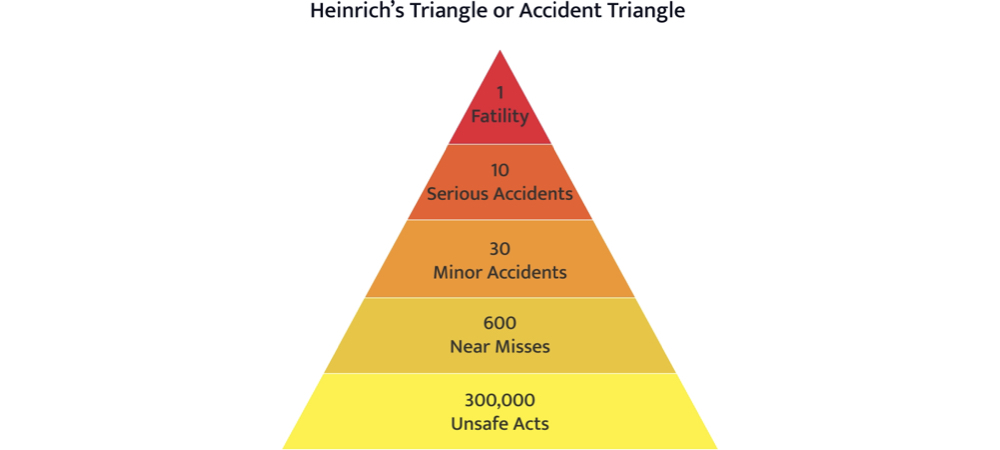
Heinrich’s Pyramid teaches us that for every serious or fatal accident, there are hundreds of near misses—"near accidents"—that foreshadowed it. Many companies invest time and resources solely in investigating the tragic event, ignoring the wealth of learning opportunities the pyramid offers: every near miss should be thoroughly investigated. Organisations should reconstruct the chain of events, identify what triggered the situation, understand the conditions that made it possible and evaluate what could have made the outcome more severe. Only in this way is it possible to address the root cause, rather than the symptom, and effectively reduce the likelihood of it recurring.

https://145358546.fs1.hubspotusercontent-eu1.net/hubfs/145358546/Heinrichs%20Triangle.001.jpeg

2.2 The Paradox of Experience

There is a widespread belief that many years of experience are a greater guarantee of safety. Unfortunately, the opposite is often true. Nobel Prize-winning economist Daniel Kahneman explained this well in his bestseller *Thinking, Fast and Slow*: to conserve resources, the brain transfers repetitive actions from the analytical system to autopilot. This is an efficient method, but it leads to a loss of what is known as “situational awareness.” In other words: people who have been doing something for years may gradually stop noticing risks that once seemed obvious. They perform the actions, but they don’t stay vigilant about the risks. 

Along with overconfidence and the sense of invulnerability that develops over years of experience, according to SafeStart, a safety training program focused on human factors, there are three other factors that make people particularly vulnerable to error:

  • hurry, which leads to skipping safety steps; 

  • frustration, which diverts attention; 

  • fatigue, which impairs judgment.

2.3 Communication Barriers

The third error is systemic and relational in nature: safety is also shaped by effective communication. Major incidents often occur when weaknesses in organizational defenses align, partly due to failures in communication. Communication barriers can flow in both directions: from the top down, when management fails to adequately promote a safety culture, does not clearly communicate risks, or does not listen to signals coming from the bottom; and from the bottom up, when workers and employees hesitate to report critical information out of fear of retaliation, mistrust, or because of the rigid hierarchy in which they operate. 

This problem is drastically amplified when managing a multicultural workforce: in environments where people of different nationalities and cultural and linguistic backgrounds coexist, safety instructions can be misunderstood, procedures may be unclear, and the hierarchical barrier can be perceived as even higher for those who do not speak the language fluently or are unfamiliar with the cultural norms of the workplace. It is necessary to adopt an inclusive and participatory leadership style that encourages open dialogue and active involvement at every level.

https://145358546.fs1.hubspotusercontent-eu1.net/hubfs/145358546/Leadership%20partecipativa.001.jpeg

2.4 “Paperwork-only” compliance

One of the most insidious mistakes is the tendency to confuse documentary compliance with actual safety. For example, maintaining an up-to-date Risk Assessment Document (RAD) does not mean having a safe workplace if that document is simply a “copy-and-paste” job, without an analysis of specific risks.
Similarly, when top priority is given to production targets and action is taken only after a breakdown has occurred, maintenance workers are exposed to high risks associated with emergency repairs.

These are four of the most common mistakes that people and organizations make when it comes to workplace safety. To avoid them, a shift is needed toward a safety culture based on behavioral training (through storytelling and simulations) and a focus on safety as a strategic investment for both people and the company.

CTA _ IND_TECH Quiz

Could you recognize a near miss before it becomes an accident? Take the quiz and find out!

TAKE THE QUIZ